Leaders' Lives: Amber Vodegel - Founder, NED, Digital Health Expert
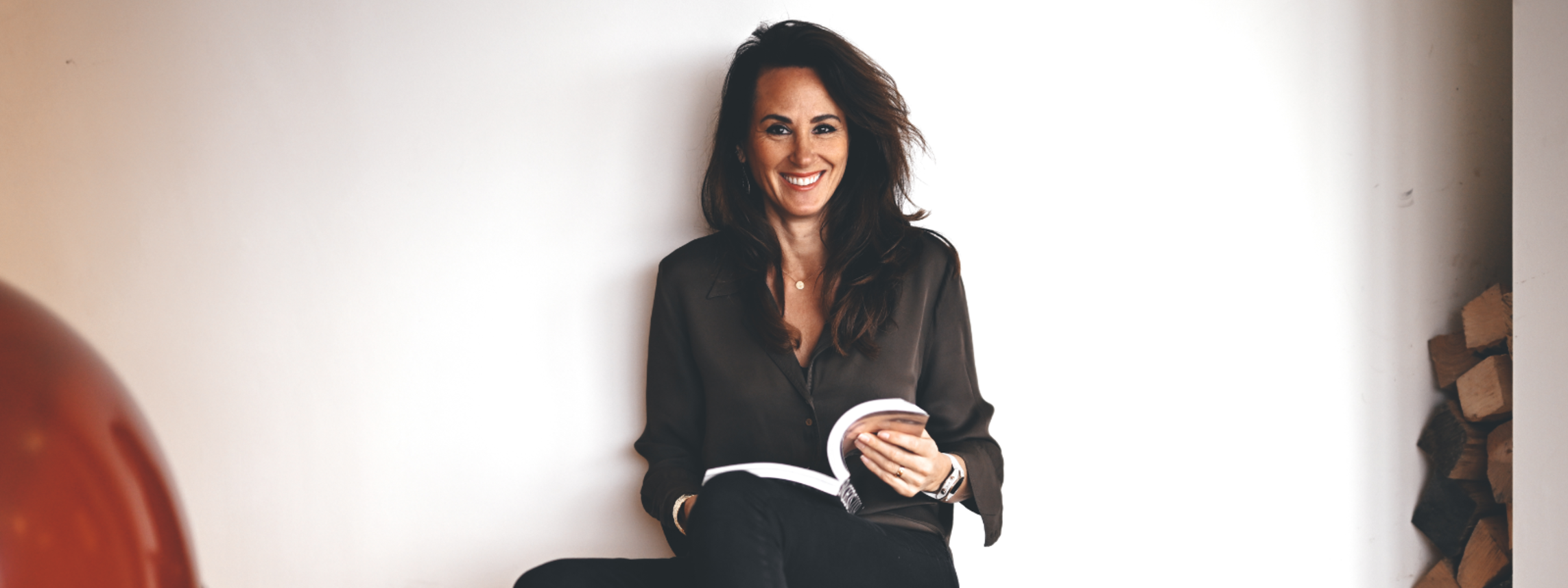
Amber Vodegel is the founder of one of the world’s biggest health apps – Pregnancy+, with 150 million users to date in over 100 countries, and 2 million daily active users. A company she bootstrapped and sold to Phillips. Here she talks about how she built her app empire, the importance of storytelling and what she learned from riding a pony around her parents’ dining table.
Amber Vodegel loves a story and she tells a good one. Not only is she the author of children’s books but her own life has some fascinating chapters too.
In fact, she even dreams in chapters - a dream she starts one night will be picked up the following evening and continued. “It started about 10 or 15 years ago. Every evening, just before I drift off to sleep, I recall my last dream, allowing me to continue the dream where I left off.” She has no idea why and knows no one else who dreams this way. Neither do I, but then Amber strikes me as something of a one-off.
She grew up in The Netherlands. Her parents were creative and bohemian, abandoning a life in Amsterdam running an art gallery, for life in the countryside. “They were part of a liberal intellectual exodus of people from Amsterdam who envisioned a rural life in the countryside. They dreamt of a vegetable patch and baking their own bread.” And it didn’t get much more rural or quintessentially Dutch than the little village they ended up in with their two young children.
“Our village had a population of just 1,000 and our house was located next to a windmill and a dyke,” she tells me. But it also turned out to be “very Calvinistic,” something which meant that the more free-thinking city families didn’t entirely fit in. “My school was very small, with only eight children in my class, and I often felt like an outsider,” she tells me.
Despite this, those early years were idyllic. Young Amber had a lot of freedom, cycling to school and roaming free both in nature and at home, which was a suitably radical open-plan living space, designed by her dad. “There were almost no doors in our house, which was very unusual at the time. My dad painted the house completely ochre yellow, and laid black Norwegian slate floors throughout. The house was filled with art, plants and wicker hanging chairs, all in true 1970s hippie style,” she recalls.
Amber was encouraged to express herself creatively – and she remembers with fondness making 10-foot-tall chalk drawings on the slate floor and building dens throughout the house, a game that could get somewhat out of hand. “My dad introduced a rule: no more than seven dens at any one point in the house,” she laughs.
On one occasion, Amber even persuaded her parents to let her ride her friend’s pony around the dining room. Such a free childhood meant she grew up thinking that “anything was possible”. But like many stories, the good times didn’t last.
Surviving Tough Times
“My dad suffered two severe brain injuries. The first was from a road accident and the second when he contracted meningitis. Both times he ended up in a coma.”
The injuries led to a serious mental condition and her father was hospitalised. He lost his job and the relationship with her mother broke down and they divorced when Amber was ten. He continued to live in the same village.
Suddenly, life became much less carefree.
“My mother suffered from depression and spent, where she could, days with the curtains closed on the sofa or in bed. We moved to a tiny council house and lived on benefits until my mother found a job. She had never built a career herself, so she had to start from the ground up. When she started working full-time, my little brother and I had to look after ourselves during the day and in the evening we always tried to cheer my mother up in the best ways possible. My dad lived in the same village, but there were long periods when we couldn’t see him. It was very uncomfortable at times.”
She learnt a lot about self-sufficiency during that time, to the point where delegation proved to be hard in her early career. “It took me a very long time in life to realise that I can actually rely on other people and that I don’t need to do everything on my own,” she says.
But during this time, she also learned the importance of humour. “My little brother had a great sense of humour and together we tried to make the most of the situation we were in. We discovered that if you add a bit of comedy to a sad situation, you can still have a great time, no matter what! 95% of any problem is how you deal with it.”
But she admits not seeing much of her dad in her teenage years, derailed her for a long time. Watching her mum struggling financially, had a big impact on what she chose to study herself at university, opting for Finance and Economics, rather than the art or design course she had originally favoured.
The Beauty of Business
Entrepreneurship can be its own form of creativity though, and building businesses was always part of her make-up.
Quite literally in fact, as make-up proved to be her first business opportunity, working as a make-up artist for fashion shows on the side while at university, and later monetising her skills by running courses for women on how to apply make-up. “I would just put an advert in the local newspaper for a ‘make-up course’ and when I had 25 participants interested, I’d book a conference room at a hotel and run a class,” she explained.
In her mid-twenties she set up a modelling agency with a friend, but she didn’t enjoy what she describes as a “fickle” industry.
It was also around this time that Amber published her first 2 books. Children's story books about Maths that she wrote together with her mum. An attempt to make Maths fun and bring humour to a subject many children find unenjoyable.
As a passionate advocate for education, she has some pretty radical ideas on that too, including advocating for a kind of National Service for Education. “I think everyone should be a teacher at some point in their life. If I were in government, I would encourage those who are financially independent and have reached a certain level of education or experience, to give two years of their life back to education.”
Her own marriage, to a fellow entrepreneur, was less well-balanced though.
“He failed to tell me that he had signed personal liabilities for his companies in Germany and two months after we got married we got a phone call from his business partner to say that there was an “issue”. I was 26 years old, and we now had millions of guilders of debt. I never told my parents.”
The pair worked hard to dispute the claims and pay off the remaining debt that was owed, rather than declare bankruptcy. But it took a toll on their relationship. “I borrowed the last 20,000 from my dad so that we could negotiate another bank deal. The day I paid my dad back the money, was the day I felt our marriage was over. Simply too much had happened.”
Changing Tides
Another chapter over, and Amber found herself, aged 32 and now living in the UK, having to “start all over again”. And it was not just her personal life that needed rebuilding, but professionally too as she decided to move out of finance and into the world of digital advertising and the burgeoning industry of online ads.
“I knew nothing about cookies, pixels and tracking ads - but I absolutely loved advertising,” she said. The CEO of the agency became an important mentor to her. “He really taught me how to run a business and how not to be scared to try things out. He encouraged many people in the company to set up their own businesses on the side, whilst we were still working there. Many people who worked for that agency, now run their own successful companies.”
This business freedom meant Amber could start dabbling in the world of apps in 2009, first toying with the idea of a diet app, before pivoting to a pregnancy app, after she noticed how profitable and underrepresented these apps were.
This was still very much a side hustle for her, as she didn’t want to quit her day job at the advertising agency until she was sure she could make enough money for her family to have security.
But even though it was a second job, she still gave it her all.
“I was obsessing over customers. In the beginning I answered every single customer service ticket myself. I was working till 11pm most evenings on the App, whilst still having my day job at the advertising agency. In the end we had over 80,000 customer service tickets and 100,000 app store reviews to respond to every year so that got impossible, but I would still skim through many of the reviews, simply because I wanted to know what exactly people liked and what they didn’t. Stressing over your customers is key.”
She bootstrapped the business, and the money she made was ploughed back into the app to constantly improve its content, graphics, and code. “We did this for five years, and in the end, we reached 10 million users. Then sold the company to Philips,” she says. Now the Pregancy+ App has served over 150 million users to date, with two million DAU. "With it came a lot of responsibility", she says. "If you advise two million women a day not to consume alcohol during pregnancy, it leads to so many more healthier babies and mother."
The Next Chapter - Dreaming Big
Amber turns 50 this year and while part of her wants a slower pace of life – indulging her love of playing tennis and building out her non-executive portfolio – she also believes there is at least one more business in her. And characteristically she is dreaming both big and radical.
“I once built the biggest pregnancy app, so let’s try to build the biggest period app in the world”, she tells me.
She says she doesn't agree with the current period apps on the market, partly because of their design but also because they ask for expensive subscriptions, disproportionally impacting women of lower socioeconomic levels. "Menstrual health should not sit behind a pay wall," she says. Instead she wants to demystify the subject and educate girls and women on a subject that remains taboo.
“Children as young as eight have periods today, and a large percentage struggle to afford period products. Why is there no good education? What level of period pain is normal? What is a heavy flow? People just don’t talk about it.”
Not only will her app be completely free-to-use but she also will reinvent the way it stores sensitive health data. A completely new architecture will support on-device AI, without the need to store women’s health data on external cloud servers.
“Everyone says ‘data is money’ so collect as much as possible and retarget it or resell it. But this solution is not about money. This is about building trust and moral ambition. If we don't collect and store any data, we totally eliminate privacy concerns and security risks. Plus, running an app without any cloud servers is also very sustainable and cost-effective.”
In her free time, Amber is also writing another book, together with her teenage children - and it is very much a team effort. Her daughter makes all the illustrations, and her son adds elements of humour to the story. The book is about births who fly and live underground and travel super-fast through earth tunnels and only come above ground to warn humans about global warming.
Despite having worryingly good organisational skills when it comes to dreaming, Amber says she hasn’t always had the same abilities when it comes to work/life balance. “I used to work day-and-night. Work was literally my identity.” But after her second divorce, she was forced to re-evaluate how she did things and she learned a very valuable lesson from the man who is now her life partner.
“He owns a very successful business, but he works only a few hours a day. Initially I thought, how is that possible? But I soon realised it’s a matter of focus and prioritisation. I’ve learned a lot from just watching him work. I’m now trying to start work a bit later in the morning and go to the gym or play some tennis with friends. My work week is slightly less packed and I have a lot more time to think and time to go and see my kids play hockey and cricket.”
And of course, she hopes the storytelling will continue at Boardwave.
“I love the openness and support of the Boardwave network. Becoming a member of Boardwave was the best decision I made last year. People say, ‘we struggle with this problem - who can offer insights?’. Mentoring other companies is very rewarding, and I've met so many amazing leaders. I love how Boardwave has created an environment where senior leaders are not embarrassed to ask questions that make them feel vulnerable.”
Tips From The Top
What are your top three tips for business success?
-
Always focus on the long term.
-
Obsess over your customers.
-
Hire the best people.
What was the best advice you ever got?
Time is the only thing you can’t buy, so use it wisely.
Tell me something surprising about you?
- I published two maths books for children in The Netherlands when I was 26. I’m now writing another children's book together with my own children, a book on global warming.
- I’m really bad at remembering people’s names, no matter how hard I try. But I can always remember the stories they told me, or the clothes they wore :-)
- When I wake up in the morning I can’t remember my dreams, but just before I fall asleep at night, I recall my last dream and then continue the same dream where I left off – it’s very strange!
What tech (other than your phone) would you not be without?
Is a dishwasher, a hairdryer or a washing machine classified as tech? If so, I would put those on top of my list. I love ChatGPT but doing the dishes with dripping wet hair and unbrushed teeth…. maybe not!
What would you have done if you hadn’t been an entrepreneur?
I have always wanted to be a math teacher. Rethinking the way maths is taught and making it more enjoyable for children.